
Limited-Time Offer: 2ft. X 4ft., Outdoor Double-Sided, Hi-Res LED Digital Sign: $4,899 Shipping Included

Real-time public communication, emergency-ready alerts, and lower long-term messaging costs.
Municipal buildings are information hubs, City Hall, police and fire stations, libraries, community centers, courts, and public works facilities all need to communicate clearly and quickly. LED digital signs make it easy to publish timely updates, improve wayfinding, and deliver critical public safety messaging without the delays and recurring costs of printed posters and manual sign changes.
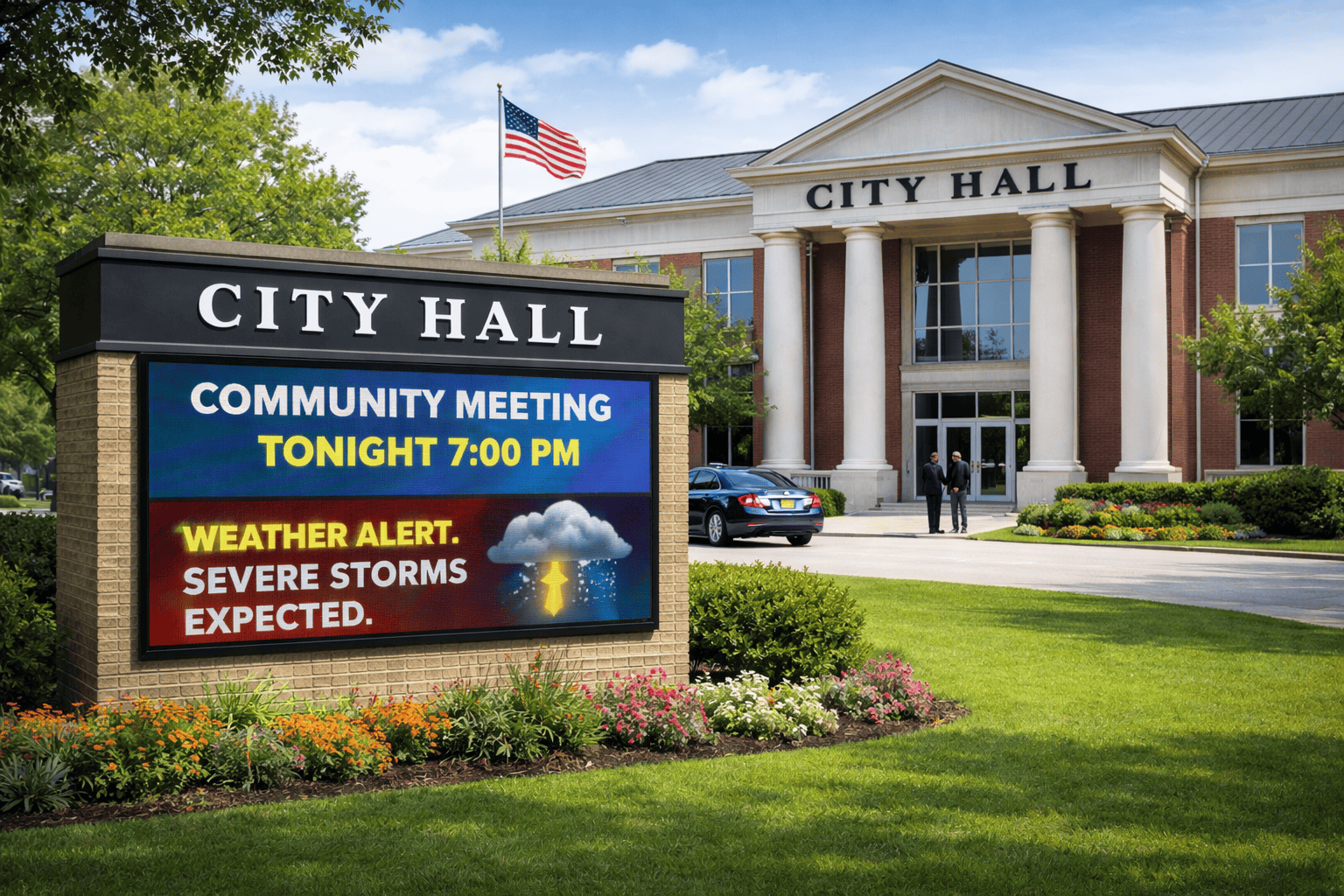
From daily operations to emergency communications, LED message centers and digital displays help government teams share the right message at the right time—indoors and outdoors.
Update messages in minutes (not days) for:
Office hour changes, closures, holiday schedules
Meeting notices, agendas, public hearing reminders
Program announcements, community events, deadlines
Road closures, detours, parking updates, service disruptions
LED signs support high-visibility emergency messaging and can be configured to override normal content for urgent alerts. Many organizations align alert workflows to Common Alerting Protocol (CAP) standards, and the U.S. government’s FEMA Integrated Public Alert & Warning System (IPAWS) is CAP-based—making CAP a common format for public warnings. (FEMA)
Use cases include:
Weather alerts, evacuation routes, shelter locations
Amber alerts and public safety notices
Facility lockdown instructions (for indoor displays)
Citywide service interruptions (water, power, transit)
Digital signage can significantly reduce the ongoing costs of printing, posting, replacing, and distributing paper notices especially across multiple buildings. (risevision.com)
It also reduces staff time spent making updates manually (and helps avoid outdated signage remaining posted).
Indoor displays improve clarity and reduce confusion for visitors:
Check-in instructions and queue guidance
Document requirements (“Bring 2 forms of ID…”)
Department directories and wayfinding
Multilingual messaging for diverse communities
Whether you manage one facility or a citywide network, digital signage lets you publish approved messages consistently helpful for compliance, public notices, and interdepartmental coordination.
ROI for municipal digital signage typically comes from hard savings (printing + labor) and operational gains (fewer repetitive inquiries, fewer missed appointments, faster updates). Many digital signage providers and industry summaries cite payback windows commonly in the 1–3 year range, depending on the number of displays and how much print/labor is replaced. (Visix)
Practical ROI drivers for municipal buildings
1) Print cost reduction
Fewer posters, banners, temporary directional signs, and reprints
Less vendor printing and rush jobs
(Organizations routinely cite printing reduction as a primary measurable benefit.) (risevision.com)
2) Labor savings
Less staff time spent creating, distributing, and replacing signage
Faster updates across multiple buildings from one dashboard (touchsource.com)
3) Reduced call volume for common questions
Clear “what to bring / where to go / what’s open” messaging lowers front-desk and phone demand (often a major hidden cost in public-facing offices).
Example payback scenario (simple, realistic)
(Illustrative example—actual ROI depends on your current print volume, labor rates, and number of facilities.)
A single City Hall installs one outdoor LED sign plus two indoor displays.
Annual impact estimate:
Printing & posting savings: $2,500–$7,500/year (posters, flyers, temporary directional signage, replacements)
Labor reclaimed: 2–6 hours/week across departments (updates, posting, replacing, coordinating)
Operational improvement: fewer repeat inquiries and fewer missed visits due to clearer instructions
Typical outcome: Many municipal setups see payback in 12–36 months, with stronger returns when signage is deployed across multiple departments or multiple buildings. (Visix)
Can we update messages remotely for multiple buildings?
Yes. Municipal teams commonly manage content from one central dashboard to keep messaging consistent across sites.
Can the sign display emergency alerts?
Digital signage can be configured for emergency override messaging, and many alert ecosystems use CAP-based formats. (FEMA)
How long does an LED digital sign last?
Service life varies by product and operating conditions (brightness settings, weather exposure, duty cycle). We’ll recommend options based on your location and runtime needs.
Will it be bright enough in direct sunlight?
Outdoor LED signs are built for daytime visibility. Brightness selection depends on placement, angle, and ambient light.
Is the content easy for staff to manage?
Yes. Most teams use simple templates and scheduled playlists. We can also set up role-based access so only approved users can publish.
Can the sign support multilingual communication?
Yes. Many municipalities rotate messages in multiple languages to better serve residents.
What kind of maintenance is required?
LED signs are designed for durability, but outdoor units still benefit from periodic inspection and cleaning. We’ll outline a simple maintenance plan.
Get a fast, itemized quote for your facility. Fill out this quick form to get a quote or contact us at 305.328.9557 with any questions you may have. We usually respond within 24 hours or sometimes the same day.